



Accurate logging of social contacts

Offline logging
OpenBeacon is uniquely suited for modeling epidemics by decentralized tracking of human and animal interaction.
The OpenBeacon.org project provides active 2.4 GHz RFID real-time proximity and position tracking using the Bluetooth Low Energy compatible nRF51822 chip from Nordic Semiconductor.
Location tracking with OpenBeacon tags is implemented by running the OpenBeacon proximity tag firmware, which regularly transmits beacon packets. These packets are received by OpenBeacon base stations in the vicinity, and the signals seen by one or more base stations determine the position of each tag in real time.
The proximity feature additionally resolves human contacts by detecting other tags in a range of up to 6 metres with a resolution of approximately 0.5 metres. Once a contact is detected, the information is forwarded by the surrounding Power-over-Ethernet readers to the server infrastructure. Because the body shields the 2.4 GHz signal, face-to-face contacts are detected accurately. Optional encryption ensures that only base stations inside the system can read the packet contents.
The proximity tag hardware design and the firmware source code are public:
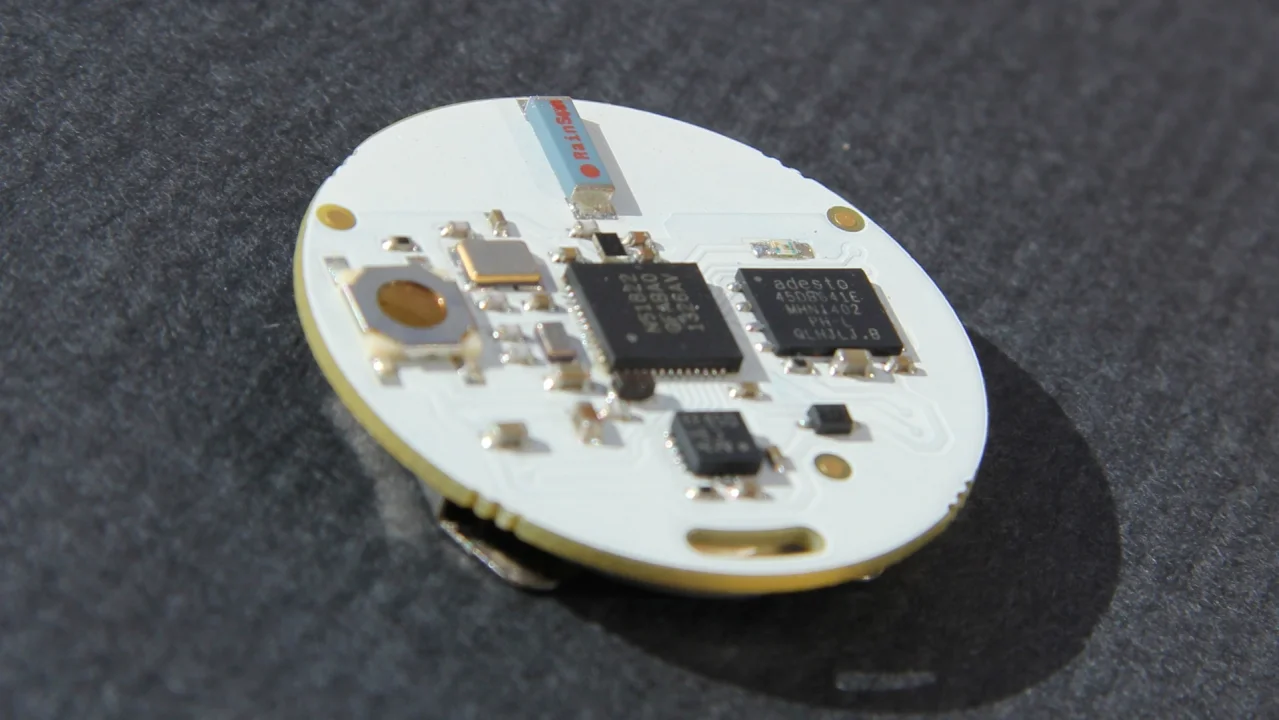
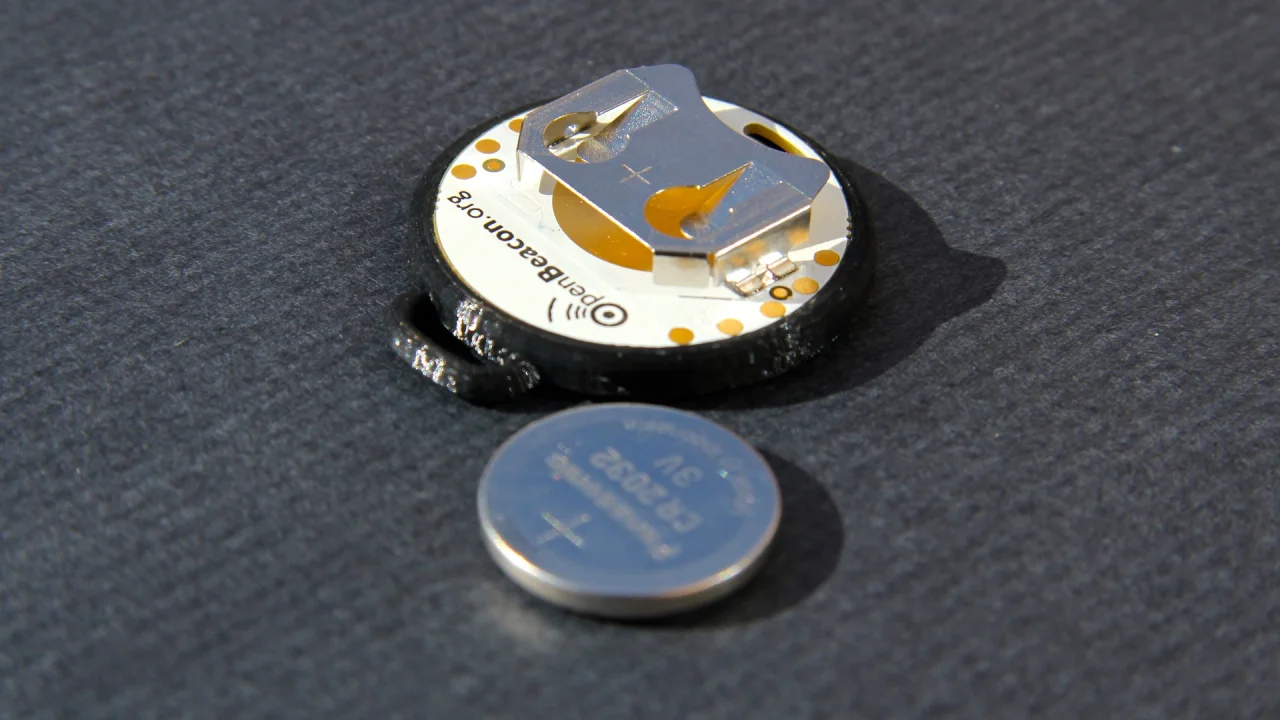
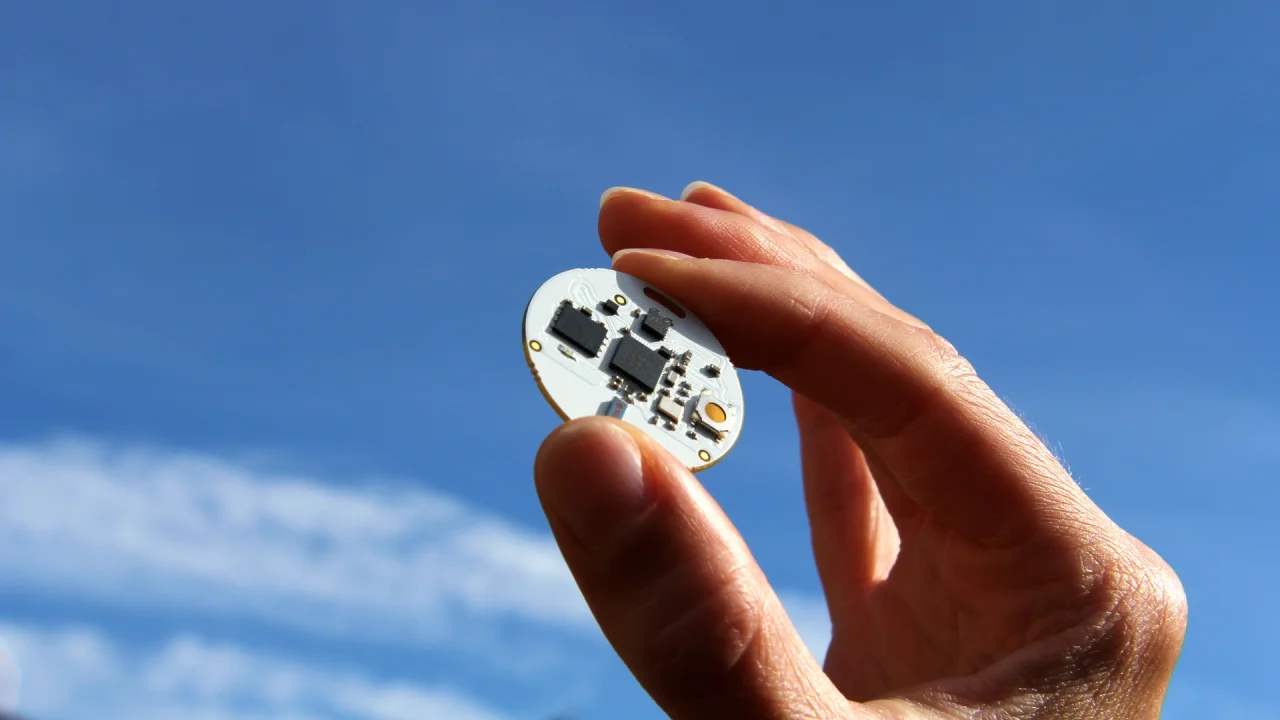
- OpenBeacon NG, the active 2.4 GHz RFID proximity tag based on the nRF51822.
- SocioPatterns.org, the research project on high-resolution social networks from wearable proximity sensors.

Live visualization and centralized logging
The tags transmit encrypted live notifications of the tags in their proximity and their approximate distance. By placing network readers in the relevant areas, tag-to-tag sightings are collected centrally, either for logging or for a live display of the interaction.
The video below shows how tag-to-tag interaction is detected and a notification is broadcast to the network infrastructure. The Live Social Semantics project integrated real-time face-to-face interaction detection using active RFID with linked data from the semantic web and from social networking sites. The system was deployed at two conferences in spring 2009; the film includes excerpts from the real-time visualization during the Hypertext'09 conference and the online social network browsing tool.
More on Live Social Semantics at sociopatterns.org (PDF); Wouter Van den Broeck's original video is on Vimeo. The song "Dreamer" was created by Geraint Luff, from the album Sky Full of Songs.
Ethernet reader: interactive 3D model

Physical Web and Bluetooth Low Energy
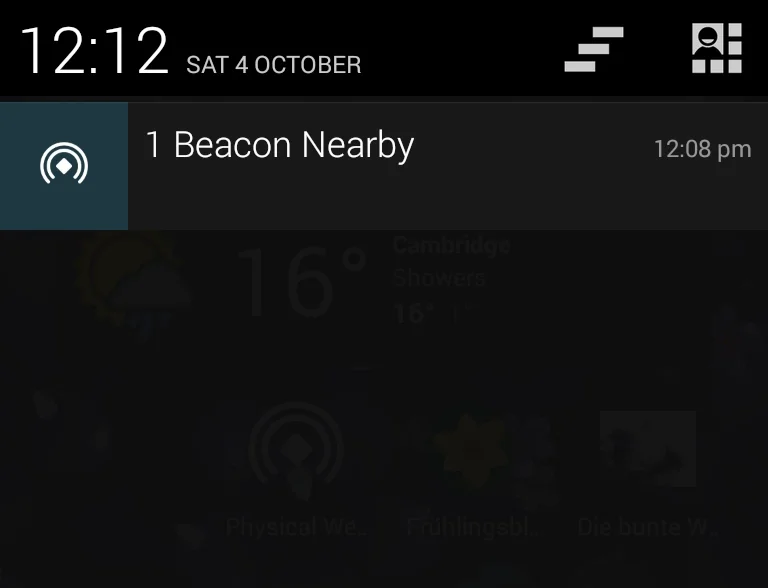
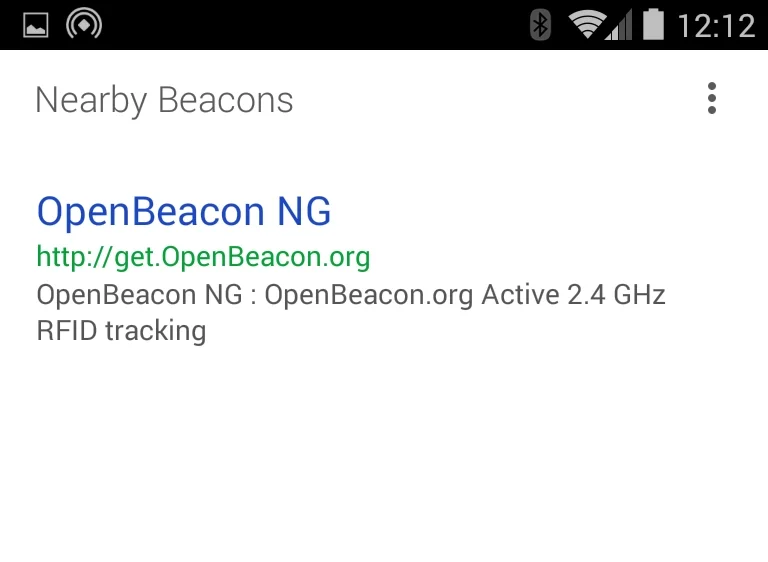
In 2014 the tag design got a second life as a Bluetooth Low Energy device. When Google published the Physical Web beacon format, OpenBeacon added the packet protocol to the existing tags: a stock tag broadcasts the URL of the project site, get.OpenBeacon.org, and the accelerometer demo transmits it only while the tag faces forward. The beaconing firmware runs on the bare nRF51822 without the vendor's SoftDevice, which is what turns the tag into a hacking, fuzzing and pentesting tool for Bluetooth Low Energy:
- tag-mischief simulates hundreds of tags with different MAC addresses at the same time, to see how a phone copes.
- Beacon packets from other beacons can be sniffed and replayed at random transmit strength, which blurs anyone's position within a radius of about 30 metres.
- The proximity firmware uses fully encrypted tag-to-tag interaction with AES encryption and packet signing, angular detection from the 3D accelerometer, a true random number generator and the 8 MB flash for logging.

Design files, firmware and tools
Everything needed to build and program a tag is collected in the how-to guide on this site and in the openbeacon-ng repository: the schematics and PCB layout as PDF, Gerber files for production, the Altium Designer sources and a bill of materials with supplier part numbers.
The firmware tree covers the whole system: tag firmware for proximity logging, Physical Web and BLE beacons, accelerometer, power and sound experiments; reader firmware for proximity and BLE readers, including one that turns a BBC micro:bit into an OpenBeacon reader for live sniffing of tag sightings; and host tools for receiving, sniffing and dumping tag logs. Development is supported on Linux and macOS with the Arm GNU toolchain; the makefiles flash a tag directly through a Segger J-Link probe from the nRF51822 development kit. The how-to guide walks through the toolchain, the Hello World firmware, flashing and reading tags. Questions go to the issue tracker on GitHub or to contact@bitqan.ae.

Full transparency
Have full control and visibility
By providing the full firmware sources and the hardware design of the tags, the security and privacy implications of the system can be verified by anyone.
Build your own tags
Anyone is free to manufacture the tags. The schematics and hardware designs are published with the firmware. The tag hardware is licensed under the Creative Commons Attribution-ShareAlike 4.0 International License, which specifically allows commercial use as long as the origin of the original design is mentioned openly.
Bitqan offers custom hardware development based on this and related designs, from a variant of the tag to a complete tracking system.
Acknowledgements
Code contributions are acknowledged in the source code headers and in the history of the GitHub repository. Beyond that, the project lives from user contributions: rigorous testing, a constant stream of feature suggestions and regular real-life deployments in the field.
The OpenBeacon team thanks Ciro Cattuto of the ISI Foundation for the great collaboration during the joint development, the ongoing support and the innovative deployments of the system, and the SocioPatterns collaboration for providing the scientific background, the media exposure and the deployments the project needed to thrive.
License
The firmware is free software: it can be redistributed and modified under the terms of the GNU General Public License version 2. It is distributed in the hope that it will be useful, but without any warranty, not even the implied warranty of merchantability or fitness for a particular purpose. Alternative licenses to the GPL are available on request: contact@bitqan.ae.
Background
OpenBeacon.org
The OpenBeacon.org project was founded by Milosch Meriac and Brita Meriac in 2006 at Bitmanufaktur GmbH in Berlin as an open platform for active RFID applications in the license-free 2.4 GHz ISM band. OpenBeacon is based on open-source software and a flexible, open design for a reprogrammable, low-cost active 2.4 GHz RFID hardware module. The tag and reader firmware sources are available under the GPL, the tag hardware schematics under a Creative Commons license, and new ideas for OpenBeacon setups and firmware improvements are encouraged.
SocioPatterns.org
SocioPatterns is an international research collaboration that uses wearable proximity sensors to map human spatial behaviour in environments such as schools, hospitals, offices and social gatherings. Over six years the SocioPatterns researchers designed and supervised more than 25 data collection campaigns in 10 countries, involving over 50,000 subjects. The resulting high-resolution social networks, shared with the public whenever possible, have been used to investigate human mobility, time-varying social networks, infectious disease dynamics, location-based services and more, reported in more than 30 peer-reviewed publications and featured by the international press.
The SocioPatterns collaboration was founded by researchers and developers from:
- ISI Foundation, Turin, Italy
- CNRS, Centre de Physique Théorique, Marseille, France
- ENS Lyon, Laboratoire de Physique, Lyon, France
- Bitmanufactory, Cambridge, United Kingdom
OpenBeacon hardware
Since the start of the project in 2006, several generations of tags have been designed for the interaction of people, animals and buildings. The latest tag hardware is documented on GitHub; earlier designs are shown in the hardware photo gallery.


